
The right mosquito mesh depends on more than the fabric: the opening’s shape, frame depth, traffic level, pest size, and available installation space all affect the result. By the end, you will know how to match mesh, panel style, track, and measurements to each window or door before ordering.
Key takeaways
- Choose 18×16 mesh for ordinary mosquitoes and balanced airflow.
- Use finer mesh when biting insects are smaller than mosquitoes.
- Match pleated, roller, sliding, or fixed screens to daily access needs.
- Measure the opening and surrounding clearance before ordering a screen.
Start With the Pest, Airflow, and Damage Risk
Choose 18×16 mosquito mesh for ordinary mosquitoes, unless smaller biting insects or physical damage changes the decision. A standard fiberglass screen mesh at this size provides a practical balance between insect control, airflow, daylight, and easy cleaning. The first number counts openings per inch in one direction; the second counts them in the other.
| Option | Airflow and protection | Choose it when |
|---|---|---|
| 18×16 mosquito mesh | Best airflow and daylight; about 288 openings per square inch before yarn thickness | Ordinary mosquitoes are the main pest |
| 20×20 mesh | Finer openings with less airflow and faster dust loading | Small biting midges or “no-see-ums” enter through standard mesh |
| 20×30 mesh | Finest option here; greatest ventilation and cleaning penalty | Very small biting insects are a persistent problem |
| Pet-resistant coated polyester | Tougher, darker, and less open than standard fiberglass | Cats, dogs, or repeated impact could tear the screen |
| Solar screen | Cuts glare and solar heat gain but reduces visibility, daylight, and ventilation | Shading matters; verify its separate insect-screen specification |
Do not select fine mesh just because it sounds safer. Dust can clog 20×20 mesh and 20×30 mesh, reducing airflow further, while pet-resistant fabric can be harder to tension. A mosquito screen is not fall protection, security glazing, or a child-safety barrier; use a separately engineered guard or restraint where a person could fall.
Match the Screen Style to the Window or Door
The opening’s movement determines the screen arrangement: match a moving panel with a moving screen, and use a fixed frame only where the window itself stays closed.
| Option | Suitable arrangement | Check before ordering |
|---|---|---|
| Sliding window | Sliding window mosquito screen in the existing track | Confirm panel thickness, track depth, roller adjustment, and the interlock seal; an incorrect panel can bind, jump out, or leave a gap. |
| Casement window | Side-hinged frame or retractable casement window mesh | Leave clearance for the handle and confirm whether the sash opens inward or outward. |
| Fixed window | Fixed window screen in a removable or permanently clipped frame | Use it where ventilation access is not needed; provide a removable frame if you must clean the glass. |
| French door | Two-panel French door mosquito mesh with a centre opening | Align the meeting stile and magnets or seals so the middle joint closes without a daylight gap. |
| Balcony door | Single sliding, hinged, or side-retractable screen | Match the arrangement to the door’s travel and keep the threshold clear of feet, wheels, and cleaning tools. |
| Unusual opening | Custom-shaped fixed frame, pleated system, or segmented retractable screen | Check for enough flat, unobstructed mounting surface around every corner. |
A casement window mesh fitted over the face of the frame can obstruct hinges or prevent the sash from opening fully. For a sliding door, inspect the bottom track and rollers before selecting a replacement; a screen cannot correct a distorted track.
French door mosquito mesh and balcony-door systems are insect barriers, not fall protection. If a balcony opening presents a fall risk, install a separately engineered guard or restraint rather than relying on removable or pleated mesh.
Measure the Opening and the Space Around It
Measure the surface where the screen will sit, not the glass size. A window reveal measurement runs from finished plaster or masonry on one side to the other; a face-mounted screen uses the flat frame face instead. Mixing these reference points produces a panel that binds or leaves a permanent gap.
- Measure width at the top, middle, and bottom; use the smallest result.
- Measure height at the left, centre, and right; use the smallest result.
- Measure both diagonals. A difference between them signals a skewed opening that needs packing or adjustment.
- Check the sill with a level. A slope can lift one track edge and create a gap.
- Measure door frame depth from the outer face to the inner obstruction, including handles, locks, trim, and existing tracks.
- Record the unobstructed flat mounting width on every side where a cassette, guide, or track will sit.
Add the supplier’s specified screen installation clearance around the opening. This space prevents a pleated cassette from rubbing trim and gives a sliding panel room to run without catching the sill or frame. Do not subtract clearance from the opening unless the installation instructions explicitly require an inside-fit deduction.
For sliding doors, record the existing track width, panel thickness, roller position, and overlap at the meeting stile. A panel that fits the height but misses the track or interlock will jump, bind, or admit insects. Inspect corner joints, pile seals, and weep-hole areas before ordering; mesh cannot correct frame gaps.
Choose the Track and Operating Method for Daily Use
A mosquito screen track size should match the available frame depth, wind exposure, and frequency of use—not simply the largest profile. A thicker track can resist movement, but it also needs more clear space and can obstruct shutters, handles, or the door path.
| Option | Best choice | Trade-off |
|---|---|---|
| 1-inch track | Windows and sheltered openings with limited frame depth | Slimmer fit, but less suitable for wide doors or strong wind |
| 1.25-inch track | Regular balcony doors and frequently used openings | Good balance of rigidity, clearance, and easy operation |
| 1.5-inch track | Wider panels or openings exposed to stronger airflow | Needs more installation depth and careful alignment |
| 3-inch track | Large or heavy-wind openings | Greater stability, but can reduce passage clearance |
Choose a centre-opening mosquito screen for a wide doorway where two people pass through or furniture moves often. Use a single-handle screen door when one person normally opens it; select a double-handle system when either side needs a clear pull point.
A detachable screen suits seasonal use or openings that need unrestricted access during cleaning or repairs.
A barrier-free mosquito screen is the practical choice where a raised bottom track could trip someone, but the threshold must still close tightly against insects. Ask UNIFIRST SALES AND SERVICES to show how the selected track seals at the meeting stile, jambs, and floor.
No insect screen is fall protection, security glazing, or a child-safety barrier.
Related products
 | PLEATED MOSQUITO NET Specification : > Heavy Section Aluminium (1.25" Track) > Available 1.5" Track or 3" Track (Heavy Wind Conditions) > Foil Paper > Centre Opening,... View product → |
 | PLEATED MOSQUITO NET Detachable Specification : > Heavy Aluminium Section (1.25" Track) (2 mm Thickness) > Fibre Polyester Net (15 mm Pleat) > Available 1.5" Track or 3" Track... |
Check Seals, Maintenance, and Safety Before Ordering
A reliable screen is sealed at its edges, easy to operate, and safe for the opening; a finer weave cannot compensate for gaps at the meeting stile, threshold, side jambs, corners, or cassette.
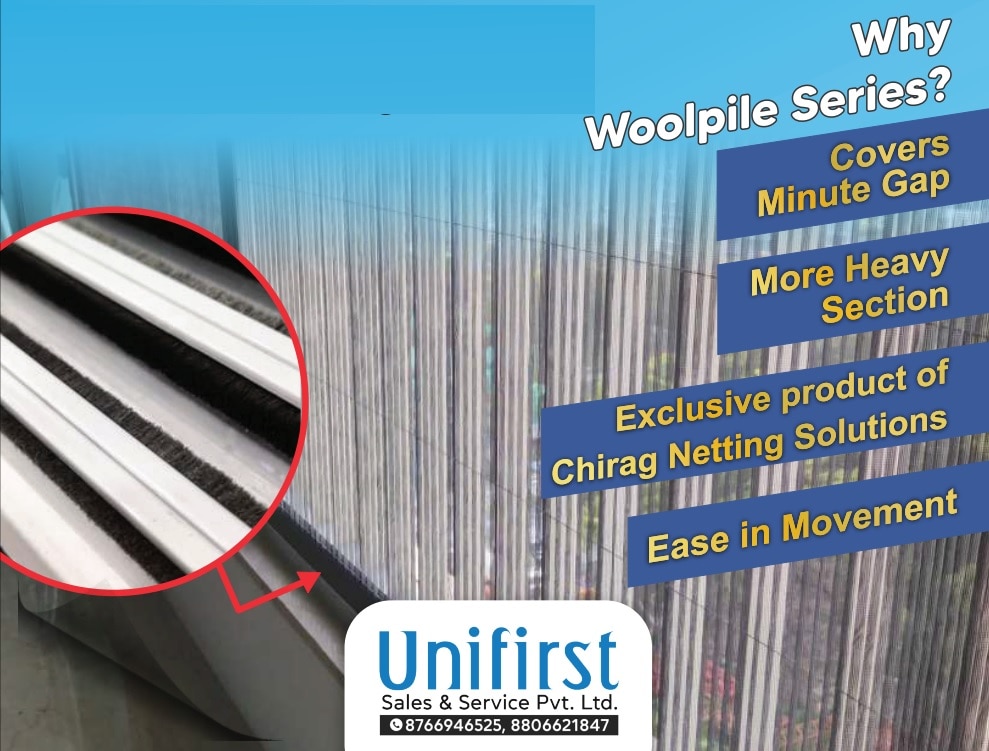
1. Inspect the complete perimeter. Ask for a closed-door demonstration and check the meeting stile, bottom threshold, side seals, corners, and cassette seating. Look for continuous brushes, rubber seals, or pile strips with no visible breaks. These are the critical mosquito screen gaps.
2. Check the existing frame before ordering. Repair failed weatherstripping, worn pile seals, unsealed corner joints, pet-door gaps, and poorly arranged weep holes first. A screen cannot seal a defective window or door.
3. Run the panel several times. It should move without scraping, lifting, or requiring force, then close fully without pleats remaining outside the cassette. On a pleated door, remove dust, grit, leaves, and pet hair from the pleated screen bottom guide; debris increases resistance and stops full closure.
4. Ask how screen cleaning is performed. Confirm whether the mesh, guide, and cassette can be reached without dismantling the frame. Choose a low-profile guide for easier daily cleaning, but recognise that a guided system gives more positive alignment than a completely trackless design.
5. Check mosquito mesh safety separately from insect control. A screen is not fall protection, security glazing, or a child-safety barrier. At frequently used doors, require a positive latch or closing method and a visible pull bar or high-contrast leading edge.
Frequently asked questions
What mosquito mesh size suits ordinary mosquitoes?
Choose 18×16 fiberglass mesh for a practical balance of insect control, airflow, daylight, and cleaning.
When should you choose finer mosquito mesh?
Choose finer mesh when smaller biting insects are present, while accepting reduced airflow and more frequent cleaning.
How do you match a screen style to a window or door?
Use a screen style that suits the opening and how often you need to open it, such as fixed screens for windows or retractable and pleated screens for frequently used doors.
What should you measure before ordering mosquito mesh?
Measure the opening width and height at multiple points, then check the surrounding frame, reveal, handle clearance, sill, and track space.
What should you check before installing a mosquito screen?
Check the mesh condition, frame alignment, track movement, brush seals, corner gaps, cleaning access, and any damage risk from pets or frequent use.
Related products
 | PLEATED MOSQUITO NET Specification : > Heavy Aluminium Section (1" Track) (2 mm Thickness) > Fibre Polyester Net (15 mm Pleat) > Available 1.5" Track or 3" Track (Heavy... View product → |
 | PLEATED MOSQUITO NET Specification : > Heavy Aluminium Section (1.25" Track) (2 mm Thickness) > Fibre Polyester Net (15 mm Pleat) > Available 1.5" Track or 3" Track... View product → |
 | PLEATED MOSQUITO NET Specification : > Heavy Aluminium Section (1.25" Track) (2 mm Thickness) > Fibre Polyester Net (15 mm Pleat) > Available 1.5" Track or 3" Track... View product → |