A balcony net can stop birds without turning the space into a sealed room, but airflow depends on more than the mesh opening. By the end, you will know how to measure the balcony, select a suitable mesh, compare net materials, and check whether the installation leaves enough open area for fresh air and required vents.
Key takeaways
- Choose mesh by opening size, exposure, visibility, and required airflow.
- Measure balcony width, height, corners, beams, and service openings before ordering.
- Close every perimeter gap and use secure fixings without over-tensioning the net.
- Remove leaves, nests, and damaged sections to preserve airflow and bird exclusion.
Why a bird net blocks birds but still lets air move
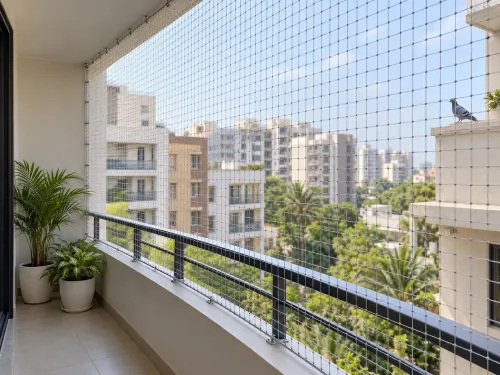
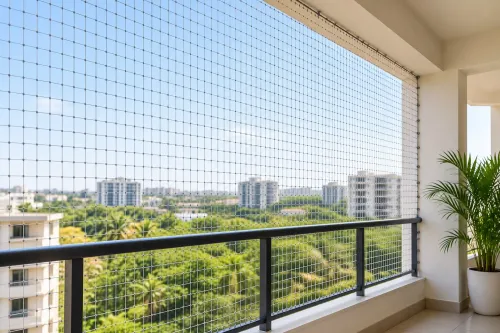
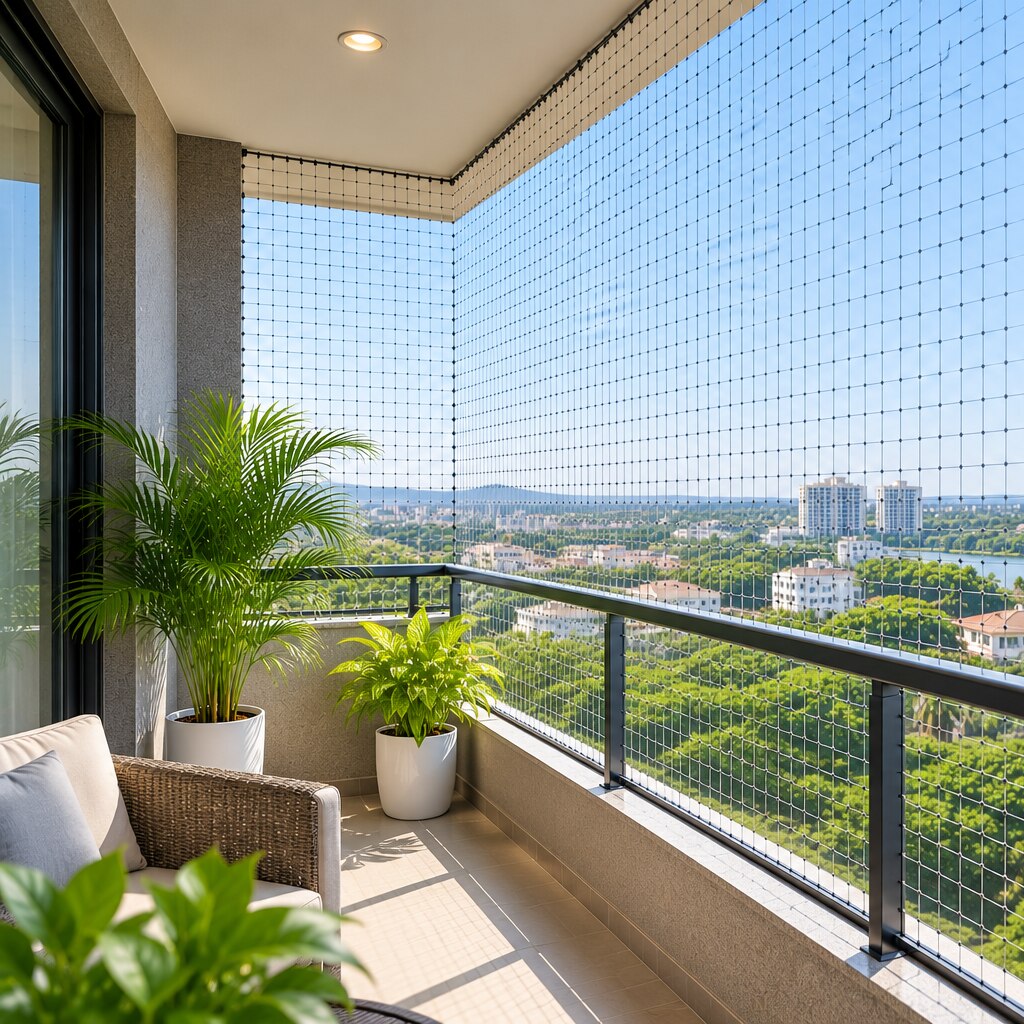
A balcony bird net creates a physical barrier, not an airtight enclosure. Birds cannot pass through its mesh openings, while air moves through the remaining mesh open area. The airflow reduction depends on the percentage of open area, twine thickness, wind pressure, and the net’s condition—not simply on the fact that a net is present.
A properly tensioned net preserves ventilation because it leaves the balcony’s broad opening exposed to moving air instead of replacing it with glass, sheet metal, or another solid panel. Excessive mesh density, sagging sections, folded overlaps, or a frame placed across the main air path can reduce effective airflow.
A net also cannot correct an undersized or blocked ventilation system inside the home.
Keep the net clear of any required ventilation opening, flue terminal, extract outlet, or air-intake grille. Covering one can restrict combustion air or prevent stale air from leaving. Fine insect screening is a different solution: its smaller openings usually create more resistance and collect more dust than bird mesh.
Inspect the net after installation. Dust, leaves, soot, bird debris, and frost can progressively close the openings, turning good initial ventilation into poor airflow. Clean blocked areas, repair tears, and replace damaged or sagging sections before birds exploit gaps or the mesh becomes a trap.
Measure every opening before choosing the mesh
The correct mesh size and a complete balcony measurement determine whether birds stay out without unnecessarily reducing airflow. Measure the clear width and height of every opening, not just the largest face, because a small unprotected corner can defeat a net covering the rest.
Record these details before ordering:
- Width and height at the top, middle, and bottom of each opening; uneven readings reveal sloping edges.
- Corner-to-corner diagonals, which expose a frame that is out of square.
- Projections such as slab lips, beams, railings, drainpipes, air-conditioning units, and light fittings.
- Door swings, service penetrations, drain outlets, and irregular edges that need a closed perimeter.
- The fixing substrate at each edge, such as concrete, masonry, metal, or a weak surface; this affects safe tensioning.
- The mesh size and ply count. Ask whether ply count means the number of strands or layers, and compare like with like.
| Mesh choice | Bird-exclusion use | Airflow and visibility trade-off |
|---|---|---|
| 19 mm mesh | Small birds such as sparrows | More restrictive visually than larger openings |
| 35 mm mesh size | Intermediate choice; confirm against the birds present | Balances exclusion and openness only when small birds cannot pass |
| 40 mm mesh size | Intermediate-to-larger birds; verify the gap is adequate | More open than 19 mm, but not suitable for every species |
| 50 mm mesh size | Commonly used for pigeons | Higher risk of smaller birds entering |
Choose the smallest mesh that excludes the birds you actually see. An unnecessarily large opening preserves openness but creates a passage.
Choose between transparent nylon and HDPE by exposure and appearance
For balconies receiving strong UV exposure, UV-stabilised black HDPE usually offers the best balance of durability, heat tolerance, cleaning, and cost-effective appearance. Choose transparent mono-filament nylon when preserving the view matters more than maximum outdoor longevity.
| Material | Visibility and appearance | Durability and heat | Cleaning |
|---|---|---|---|
| transparent mono-filament nylon | Least noticeable against open sky; preserves the view better than coloured netting | Prolonged UV exposure and intense heat can weaken unstabilised nylon; verify its outdoor UV treatment | Smooth strands rinse easily, but dirt and yellowing become conspicuous |
| black HDPE | Visible at close range but visually recedes against railings and shaded backgrounds | Best all-round outdoor choice when UV-stabilised; black netting absorbs more sunlight and can become hotter | Hides dust better; wash with water and mild soap |
| white HDPE | Bright and easy to see, so it creates a stronger visual presence | UV-stabilised grades resist outdoor exposure; the lighter colour reflects more sunlight | Shows dust, bird droppings, and pollution quickly |
Ask for the material grade and UV-stabilisation details rather than accepting a promised service life. No fixed lifespan applies to every balcony: sunlight, heat, wind movement, pollution, abrasion, and cleaning chemicals all change the result. Avoid chlorine, solvents, and stiff brushes unless the manufacturer approves them.
Select corrosion-resistant fixings as well; a durable net fails when its anchors rust or loosen.
Use perimeter closure and careful fixing to protect airflow
A closed, tensioned perimeter stops birds finding escape gaps without turning the balcony into a sealed box. Keep the mesh close to the slab, ceiling, side walls, and door frame; do not leave folds, loose overlaps, or pockets that can catch wind and push the net away.
Perimeter anchoring must suit the actual substrate. Masonry, concrete, metal railings, painted surfaces, and uPVC frames need different anchors or clamps, and adhesive alone is a poor choice where heat, dust, or moisture can weaken the bond.
Ask the installer to specify the anchor type and fixing spacing rather than accepting a vague promise of “strong fixing.”
Close these points during the site check:
- Both balcony corners, including the junction between the ceiling and side walls
- Slab edges, railing ends, drain outlets, and downpipes
- Air-conditioning pipes, electrical conduits, and other service penetrations
- Door edges and any section that must open for access
A corner closure folds or joins the net tightly into the structure instead of leaving a triangular opening. Set net tension evenly: slack mesh creates bird-sized pockets, while excessive tension can pull anchors out or damage a weak surface.
| Installation choice | Airflow result | Main failure risk |
|---|---|---|
| Perimeter anchoring with even fixing spacing | Preserves the mesh’s open area | Poor substrate selection can loosen anchors |
| Adhesive-only attachment | Adds little physical obstruction | Heat, dust, or moisture can release the edge |
| Loose overlap or sagging net | Creates turbulence and blocked pockets | Birds push through corners or become trapped |
Keep the net effective after installation
Cleaning bird net surfaces every few months prevents dust, leaves, soot, droppings, and frost from reducing airflow. Inspect the mesh, perimeter, knots, hooks, and tension after storms; repair tears and sagging promptly instead of waiting for a bird to find the gap.
Ask the installer to prove that the design preserves each ventilation opening’s required free area. The net must not cover a flue terminal, extract outlet, air-intake grille, or air-conditioner discharge. A removable access section prevents you from cutting the net later to reach drains, glazing, or outdoor equipment.
Before approving the work, check these points:
- The perimeter closes corners, slab edges, drain outlets, door gaps, and service penetrations.
- The access section opens without leaving a permanent bird-sized gap and can be secured again.
- The installer states the expected service life for the chosen material and fixing system, including exposure to sunlight and monsoon weather.
- The net is labelled as bird exclusion, not fall protection; ordinary balcony netting is not an EN 1263-1 safety net.
- No active bird nest or eggs will be trapped behind the installation; arrange wildlife advice before sealing the area.
Ask UNIFIRST SALES AND SERVICES to mark ventilation openings and access points on the measurement drawing, not merely promise to leave them unobstructed. A fine insect screen is a different replacement: it catches smaller particles but creates greater airflow resistance and needs more frequent cleaning.
Related products
 | BIRD NET Bird netting or anti bird netting is a form of bird pest control. It is a net used to prevent birds from reaching certain areas. View product → |
 | BIRD NET Material Composition / Types > Mono Filament Net > Transparent > 35 mm > 3 years warranty Fittings > Hooks > Rope Wire > Tie View product → |
Frequently asked questions
Why does a bird net still allow air to move through a balcony?
A bird net is a physical barrier rather than an airtight enclosure. Air passes through its open mesh area, while airflow reduction depends on mesh openness, twine thickness, wind pressure, and net condition.
What should you measure before choosing balcony bird netting?
Measure every protected opening, including width, height, corners, beams, columns, railings, and service gaps. Record irregular angles and identify points where the perimeter fixing will attach.
Which is better for a balcony: transparent nylon or HDPE bird netting?
Choose transparent nylon when a less visible appearance matters. Choose HDPE when the installation faces strong exposure and you prioritise material durability; compare mesh opening, twine thickness, colour, and fixing requirements.
How do you keep a balcony bird net effective without reducing ventilation?
Close the perimeter so birds cannot enter through gaps, keep the mesh evenly tensioned, and avoid unnecessary overlapping layers. Inspect and clean the net so leaves, nests, and damage do not restrict airflow.