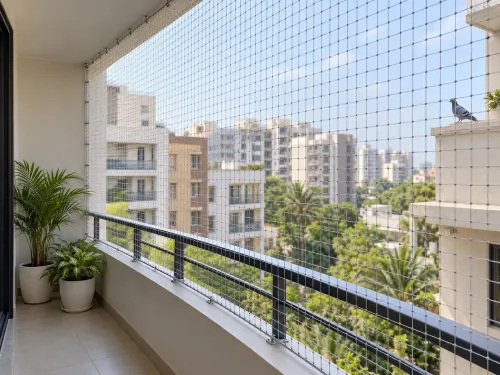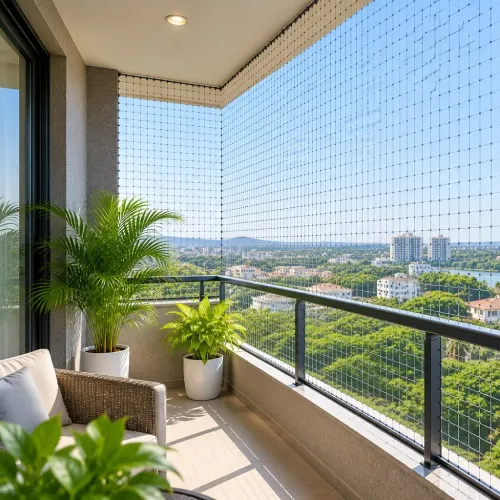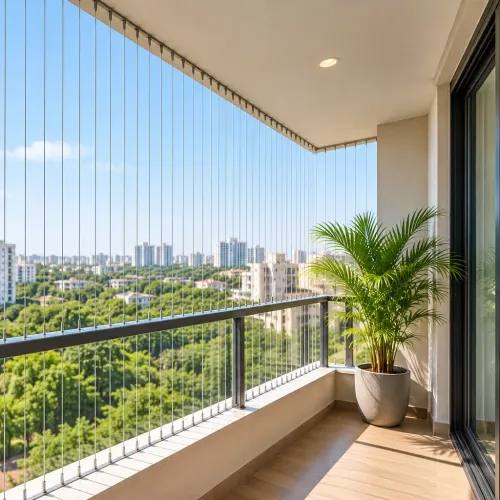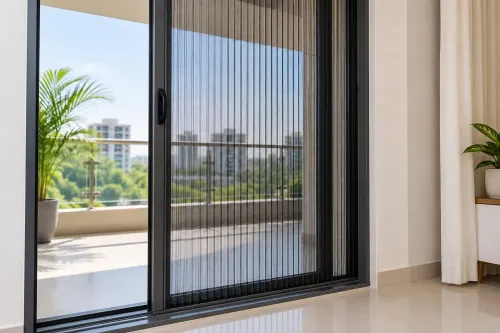
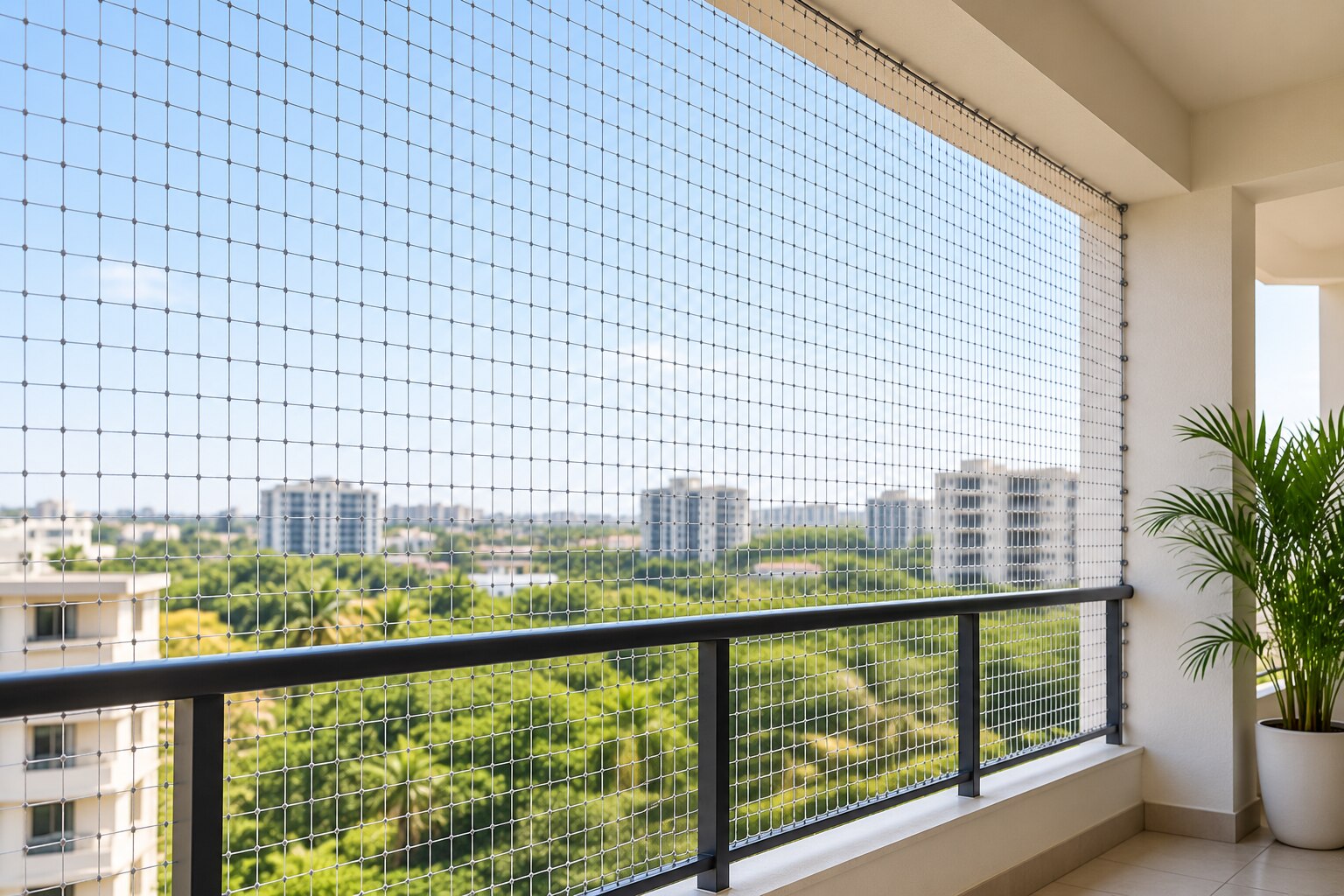
An unprotected balcony, shaft, stairwell, terrace, or service opening can admit birds and debris while exposing people to falls and accidental access. By the end, you will know which mesh type fits the hazard, what loads and fixings to specify, and how to check that the finished barrier remains safe.
Key takeaways
- Do not use mosquito mesh as a fall-protection barrier.
- Match mesh strength and anchors to the expected load.
- Choose openings that block the target hazard without trapping debris.
- Inspect tension, fixings, corrosion, and damage after installation.
What Holding Mesh Protects Against in an Open Area
Holding mesh controls hazards at an opening by retaining loose material, blocking access, or excluding birds. A practical holding mesh definition is a tensioned barrier fixed around an open edge, void, or service route. It supports open-area protection, but ordinary mosquito mesh is not designed to stop a person falling.
The hazards it can control include:
- Falls caused by someone stepping or leaning into an unguarded opening, only when the mesh has a tested fall-protection design and suitable anchors. EN 1263-1 covers temporary safety nets; a decorative or insect-control screen does not meet that standard simply because it looks strong.
- Falling objects such as tools, packaging, or loose building material.
- Bird entry and nesting inside ledges, shafts, ducts, and covered utility spaces.
- Debris carried by wind or dropped into lower areas.
- Accidental access by children, pets, or workers into restricted voids.
Holding mesh is used across balconies, shafts, stairwells, atriums, terraces, parking areas, and service ducts. Bird-exclusion mesh works only when its edges, corners, service penetrations, and overlaps are closed; a small gap or slack section can reopen the route. Bird spikes deter perching but do not form a complete barrier.
Treat the mesh as a screen or exclusion barrier unless a documented design confirms resistance to impact, wind, water accumulation, and human loading. Never use insect mesh or bird netting as a substitute for a compliant guardrail or certified fall-arrest system.
How to Specify Loads, Anchors, and the Supporting Structure
A mesh barrier is adequate only when its weakest part—the mesh, frame, anchors, or supporting substrate—can resist the forces at that opening. Appearance proves nothing: ordinary mosquito mesh and bird netting are not substitutes for a guardrail, balustrade, or certified fall-arrest system.
1. Define the hazard and load cases. State whether the barrier must resist a person leaning or falling against it, an impact load, wind uplift, water accumulation, or falling objects.
Include the opening’s span, height, edge condition, and the clearance below; a net that lets someone strike a slab, pipe, or unprotected edge before arresting the fall has not solved the hazard.
2. Specify a suitable system. A fall-protection mesh or load-bearing safety net intended for people needs documented testing and a design basis referencing EN 1263-1 where that standard applies. Do not treat a decorative screen as compliant because it looks taut or has a certificate for insect exclusion.
3. Design the load path. An engineer must check the mesh, perimeter frame, anchors, hooks, ropes, and cables together, then verify the supporting concrete, masonry, steel, or timber for pull-out, shear, bending, and local cracking. Strong hardware fixed to weak masonry still produces a failed barrier.
4. Require drawings showing anchor spacing, fixing depths, corner details, pretension, joints, and access points. Obtain the manufacturer’s test data and an installation inspection record before relying on the barrier. Recheck the design after drilling, modifying the opening, or adding equipment that changes wind or water loading.
Choosing the Opening Size and Mesh Material
Choose the mesh aperture according to the smallest hazard you need to exclude. A tight opening blocks smaller birds, bats, insects, and windblown debris more effectively, but it also reduces airflow and daylight. A wider mesh improves ventilation and visibility while allowing smaller pests through.
Material affects service life as much as aperture:
| Option | Strengths | Limitations |
|---|---|---|
| HDPE | Lightweight, flexible, and suited to bird exclusion | Can degrade under prolonged ultraviolet exposure if the grade lacks UV stabilisation |
| Nylon | Soft, light, and easy to tension around irregular openings | Stretching and weathering can create gaps over time |
| Polyester | Better dimensional stability than many soft nets, with clear visibility | Check its UV rating before using it in full sun |
| Wire mesh | Strong resistance to abrasion, rodents, and debris | Heavier, more visible, and vulnerable to corrosion if the coating fails |
| Invisible grills | Minimal visual obstruction for fall-risk openings | Require engineered wires, fixings, and substrate; they are not bird netting |
| Conventional metal grills | Rigid and durable physical guarding | Block more of the view and airflow than discreet mesh systems |
For pigeons, close the perimeter as carefully as the central panel: seal corners, service penetrations, and edges, then tension the mesh so it cannot sag into a reachable pocket. Use insect mesh only for insects; it is not a guardrail or fall-arrest system.
If durability matters in an exposed opening, compare UV resistance, tear strength, corrosion protection, and replacement access—not aperture alone.
How to Plan a Complete Installation Around Real Building Use
Before fixing anything, walk the opening as people use it: mark where a fall could land, where birds or debris could enter, and what must remain reachable. A balcony, shaft, atrium, terrace, parking area, or service duct needs a site-assessment checklist, not a mesh size chosen from a catalogue.
1. Record opening dimensions at several points, including diagonals and irregular corners. Note the substrate condition—cracked concrete, corroded steel, weak masonry, or concealed services—and set anchor spacing for that actual support.
2. Trace the complete perimeter. Seal corners, edge gaps, cable penetrations, and pipe penetrations; one open edge can defeat bird exclusion. Keep the mesh tensioned and away from occupants, lights, fans, vehicles, and stored equipment.
3. Check drainage before closing the area. Preserve drain outlets and prevent water from ponding on the mesh, where added weight can overload fixings.
4. Mark access panels, valves, fire equipment, and maintenance access. Use designed openings or removable sections, not an unlatched gap that birds or children can exploit.
5. Confirm fire exits, escape routes, ventilation, daylight, and equipment airflow remain usable. Bird netting is not a fall-arrest net.
6. For fall protection, calculate clearance below the net and remove projections, ledges, and lower-level hazards. A person can strike an obstruction before the net arrests the fall.
UNIFIRST SALES AND SERVICES can help assess whether a discreet screen suits the opening, but the installer must document fixings, load assumptions, access points, and inspection responsibility before work begins.
Related products
 | BIRD NET Bird netting or anti bird netting is a form of bird pest control. It is a net used to prevent birds from reaching certain areas. View product → |
 | BIRD NET Material Composition / Types > Mono Filament Net > Transparent > 35 mm > 3 years warranty Fittings > Hooks > Rope Wire > Tie View product → |
How to Keep the Barrier Effective After Installation
Inspect the barrier at a set interval based on weather, use, and the installer’s instructions, then repeat the check after storms, impact, construction work, or unusual loading. A mesh inspection must cover the fabric, edges, supports, and every point where a new access route could develop.
1. Walk the entire perimeter and look for perimeter gaps at corners, drains, service penetrations, frames, and junctions with walls or floors. Birds, children, debris, and falling objects can exploit a gap that appears insignificant from ground level.
2. Check for tears, pulled stitches, detached clips, loose fixings, broken hooks, slack ropes, and frame movement. Test the mesh visually without climbing on it; a fall-protection net must not be treated as a walkway or human restraint unless its design permits that use.
3. Look for UV exposure damage, corrosion on cables and anchors, frayed edges, and sagging sections. Sagging can bring netting into contact with occupants, equipment, lights, drains, or an obstruction below.
4. Remove leaves, dust, bird droppings, and nesting material during cleaning. Clear bird spikes and ledges completely, because accumulated material can create a new perch or push mesh away from its support.
5. Record each defect with its location and arrange repair using matching mesh, connectors, and approved fixings. Do not patch a load-bearing or fall-arrest system without a competent inspection and confirmation that its rated performance remains intact.
Frequently asked questions
What hazards can holding mesh control in an open area?
Holding mesh can retain loose material, block access, exclude birds, and protect against specific opening hazards. Ordinary mosquito mesh is not designed to stop a falling person.
How do you specify loads, anchors, and the supporting structure?
Define the load the barrier must resist, identify every fixing point, and confirm that the surrounding concrete, steel, masonry, or frame can carry those forces. Do not size the mesh without checking its anchors and support.
How do you choose the opening size and mesh material?
Select an opening size that blocks the target hazard, then choose a material that suits exposure to sunlight, rain, corrosion, abrasion, and cleaning. Avoid mesh that is too weak, too flexible, or too fine for the intended use.
What should a complete holding-mesh installation account for?
Plan around windows, doors, maintenance routes, drainage, ventilation, emergency access, cleaning, and the people who use the area. Include edge protection and safe access for future inspections.
How do you keep holding mesh effective after installation?
Inspect tension, tears, loose fasteners, damaged edges, corrosion, and changes to the supporting structure. Repair defects promptly and reassess the barrier after construction, storms, impacts, or alterations.